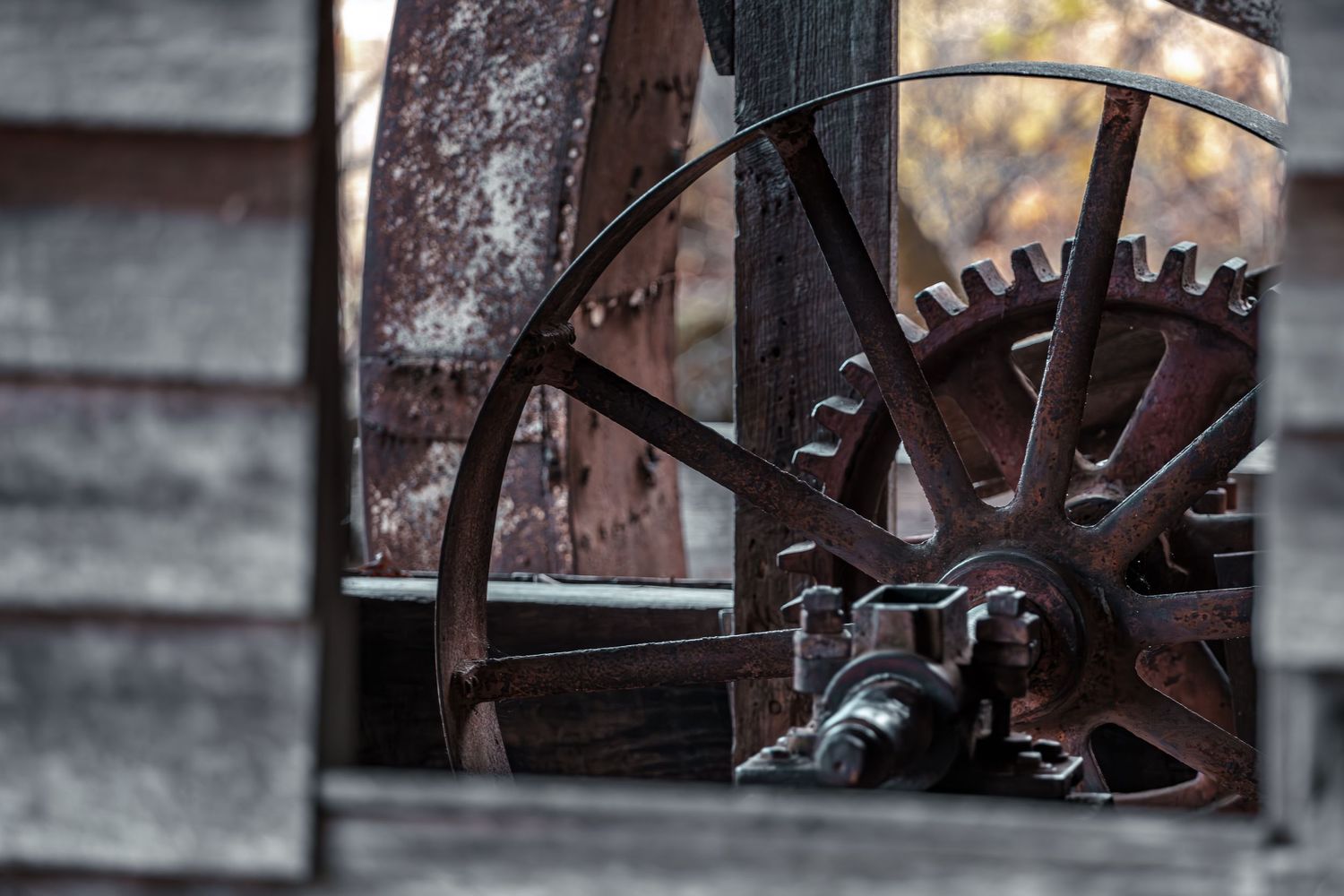
I was at Falling Spring Mill with my husband when I took this photo.
He was fishing, which meant I had time to wander around with my camera and get stubborn about angles. That happens to me sometimes. I get tired of seeing the same picture of a place over and over again, even if it is a good picture. I want to find the corner nobody pays attention to. The view through the boards. The shadowed part. The thing that still has something to say after everyone else has already walked past it.
Falling Spring Mill is one of those places that gets photographed a lot, and for good reason. It has the old building, the water, the history, the kind of scenery that makes people stop and pull out their phones. Most people want the full view. The pretty view. The one that says, “I was here.”
But that day, I kept looking at the machinery.
The gears.
Rusty, worn, tucked behind the wood, not exactly trying to impress anyone. They were not the obvious subject. They were not bright or polished or dramatic. They were just sitting there, still and quiet, part of a system that once worked because every piece did what it was made to do.
That is what held my attention.
Not because they were loud.
Because they weren’t.
They were hidden inside the mill, doing the kind of work nobody would have noticed unless they stopped long enough to look. People would have seen the water moving. They would have heard the sounds of the mill working. They would have noticed the finished product, the building, the usefulness of it all.
But the gears?
The gears just turned.
They did not need to explain themselves. They did not need to announce every movement. They did not need someone standing nearby clapping because they kept the whole thing going.
They just did their part.
And I think there is something deeply comforting in that, especially for those of us who are not naturally loud people.
Some people are made for the front of the room. They can talk easily, lead easily, speak up without feeling like their nervous system just caught fire. They know how to be heard. They know how to fill a space.
And there is nothing wrong with that when it is done with humility and love.
But not everyone is built that way.
Some of us are quieter. We notice more than we say. We pray for people and never tell them. We clean up after the event is over. We make sure the thing gets done, even if nobody knows who did it. We carry the behind-the-scenes details. We remember who looked sad, who seemed tired, who needed a little extra grace.
We serve in ways that do not always photograph well.
And sometimes, if I am honest, that can start to hurt.
Because even quiet people want to feel seen.
We may not want a stage. We may not want a microphone. We may not want to be the center of attention. But that does not mean we want to feel invisible. It does not mean we never get tired of being the dependable one in the background. It does not mean we never wonder if anyone notices the work that keeps life from falling apart at the seams.
The dishes.
The errands.
The quiet prayers.
The emotional cleanup.
The small kindnesses.
The things done without being asked.
The messes fixed before anyone else even knew there was a mess.
It is easy to feel like a gear inside the wall.
Necessary, maybe.
But unseen.
That is where 1 John 3:18 feels so honest to me:
“My little children, let us not love in word, neither in tongue; but in deed and in truth.”
Not in word only.
Not in tongue only.
In deed and in truth.
That verse does not tell us love has to be loud. It does not say love has to be impressive. It does not say love has to come with a speech, a public post, a perfect explanation, or a long announcement about how loving we are.
It says real love does something.
That matters.
Because we live in a world where people can talk a very big game. Faith can be talked about. Compassion can be talked about. Service can be talked about. Love can be talked about until the words almost lose their meaning.
But eventually, the gears either turn or they don’t.
Eventually, love becomes more than a sentence.
It becomes patience when someone is hard to handle.
It becomes prayer when no one knows you are praying.
It becomes cleaning up what you did not mess up.
It becomes staying faithful in a role that feels small.
It becomes choosing kindness when you could easily choose sharpness.
It becomes doing the next right thing without making everyone stop and look at you doing it.
That kind of love may never look dramatic.
But it is real.
And real matters more than loud.
I think quiet service gets overlooked because it does not always draw attention to itself. It is not flashy. It does not demand a thank-you before it begins. It does not stop working just because nobody noticed.
But maybe that is part of what makes it sacred.
Jesus warned us about doing good for the wrong audience. In Matthew 6, He says:
“But when thou doest alms, let not thy left hand know what thy right hand doeth: That thine alms may be in secret: and thy Father which seeth in secret himself shall reward thee openly.”
— Matthew 6:3–4
That is not a verse that gets along very well with our need to be recognized.
It pokes at us a little.
At least, it pokes at me.
Because I do not always want to admit how much I care about being noticed. I can say I do not want attention, and that is mostly true. But I do want to be understood. I do want someone to see the effort. I do want the people I love to know that I am trying. I do want the quiet work to count.
And Jesus does not shame us for wanting our lives to matter.
He simply reminds us where the truest reward comes from.
“Thy Father which seeth in secret.”
Those words settle something in me.
God sees the secret things.
Not just the sins we wish He would overlook, though He sees those too. He sees the quiet obedience. The service done with tired hands. The prayer whispered in the car. The restraint nobody applauded. The meal made. The floor swept. The person checked on. The burden carried. The small act of faithfulness that did not make a ripple in anyone else’s day but mattered in heaven.
God sees all of that.
Even when people don’t.
That is not always easy to live with, because people are louder than heaven most days. People’s approval is immediate. Their praise feels good right away. Their recognition can make a tired heart stand up a little straighter.
Heaven’s reward requires patience.
It requires trust.
It asks us to believe that what God sees is more important than what people miss.
That is hard.
Especially for introverts, deep feelers, quiet servants, and the ones who already feel like they are standing on the edge of every room. It is hard not to start measuring your worth by how often people notice you. It is hard not to compare quiet faithfulness to someone else’s visible platform.
But a gear does not become useless because it is hidden.
In fact, hidden things are often the reason anything works at all.
A mill does not run because one piece looks impressive. It runs because the parts stay connected. The water moves. The wheel turns. The gears catch. One motion leads to another. No single piece has to be everything. It only has to be faithful to its place in the work.
Maybe that is a better way to see service.
Not as a competition for who looks the most useful.
Not as a performance to prove who loves God the loudest.
Not as a stage where everyone has to announce their part.
But as obedience.
Quiet, steady, connected obedience.
There is peace in that.
There is also a warning, but it is a gentle one: our words need to have weight behind them.
If we say we love people, but never show up for them, something is off.
If we talk about faith, but refuse to serve unless someone is watching, something is off.
If we make big declarations about kindness, mercy, humility, and compassion, but leave all the actual work for someone else, something is off.
John does not tell us to stop speaking love altogether. Words can matter. Encouragement matters. Truth matters. Saying “I love you” matters.
But words without deeds become hollow pretty quickly.
A gear painted gold still does nothing if it refuses to turn.
And a rusty one, tucked in the shadows, may be doing more than anyone realizes.
That is what I kept thinking about when I looked through that old mill.
Those gears were not pretty in the usual way. They were weathered. Rusted. Marked by time. But they had a kind of honesty to them. They looked like work. Like use. Like purpose.
I appreciate that more and more as I get older.
I have less patience for shiny things that do not function.
I would rather be around people who quietly do what is right than people who loudly tell everyone how right they are. I would rather see love in someone’s hands than hear it dressed up in perfect language. I would rather be the kind of person who helps keep things turning than the kind who only knows how to point out when the machine is broken.
And yet, I know my own heart well enough to admit this: I still want to be seen.
Maybe you do too.
Maybe you are the one who prays quietly for everyone else but wonders who is praying for you.
Maybe you are the one who cleans up the mess and gets called “particular” instead of appreciated.
Maybe you are the one who notices what needs done, does it, and then watches someone else get thanked for the whole thing.
Maybe you are the steady one, the background one, the one people assume will just keep turning because you always have.
If that is you, I want you to hear this plainly:
Quiet does not mean unimportant.
Hidden does not mean forgotten.
Unnoticed by people does not mean unseen by God.
There is no shame in being a quiet servant. There is no lesser place in the kingdom for the ones who do not make a production out of every good thing they do. You do not have to become boisterous to be useful. You do not have to perform faithfulness for it to be real.
Some love looks like showing up without applause.
Some love looks like doing the thing again.
Some love looks like keeping the machine running so other people can stand on steady ground.
And some of the most Christlike work in the world is done by people whose names never make the announcement slide.
That does not make it small.
It makes it sacred.
Because God sees in secret.
That does not mean we should let people use us up. Quiet service is not the same as having no boundaries. Humility is not the same as being everyone’s doormat. Jesus served perfectly, but He was not controlled by everyone’s demands. He withdrew. He rested. He obeyed the Father, not every human expectation placed on Him.
So quiet service should not mean breaking yourself to keep everyone else comfortable.
It means doing what God gives you to do with a willing heart, even if the whole room does not turn around and notice.
It means loving in deed and truth, not because you are chasing applause, but because Christ loved you first.
It means trusting that your Father sees what happens behind the boards.
Behind the walls.
Behind the scenes.
Inside the mill where the quiet gears turn.
That day at Falling Spring, my husband fished and I hunted for a different kind of picture. I wanted something other than the obvious view. Something a little more hidden. Something that made people stop and look closer.
I think I found it.
Not just in the photo, but in the reminder.
The quiet things matter.
The steady things matter.
The hidden things matter.
And maybe, if we are honest, most of life is held together by people doing small faithful things without much fanfare.
The ones who pray.
The ones who clean.
The ones who listen.
The ones who remember.
The ones who serve.
The ones who keep turning, not because everyone sees them, but because God does.
So here is to the quiet gears.
The ones tucked inside the work.
The ones who love with their hands, their time, their patience, their prayers, and their steadiness.
The ones who do not talk a big game, but show up when it counts.
The ones learning to let God be enough of an audience.
Your service is not wasted.
Your quiet is not weakness.
Your faithfulness is not invisible.
The Father sees in secret.
And that is enough to keep turning.