Rev. Dr. Martin Luther King Jr. once said, “Darkness cannot drive out darkness; only light can do that.”
I have thought about that line many times in my life, but especially in recovery.
I am no stranger to addiction. I am no stranger to the lies that come with it, either. Not just the big obvious lies people think of when they hear the word addiction, but the smaller ones that stack up until a person can hardly tell where the truth ends and the performance begins. The “I’m fine.” The “It’s not that bad.” The “I have it under control.” The “No one needs to know.” The “This is the last time.” The “I can fix it before anyone finds out.”
Addiction does not grow in honesty. It grows in shadows.
And addiction is not always just about substances. We can become addicted to anything that starts ruling us instead of being submitted to God. Approval. Control. Anger. Attention. Food. Shopping. Drama. Pornography. Work. The feeling of being needed. The feeling of being right. The comfort of bitterness. Even the false image of having everything together can become its own kind of trap.
That is the dangerous thing about darkness. It does not usually introduce itself as darkness.
Sometimes it shows up as protection. As privacy. As keeping the peace. As saving face. As making sure nobody thinks less of us. Sometimes it sounds very reasonable when it whispers, “Just don’t tell anyone. You can handle this alone.”
But hidden things have a way of growing teeth.
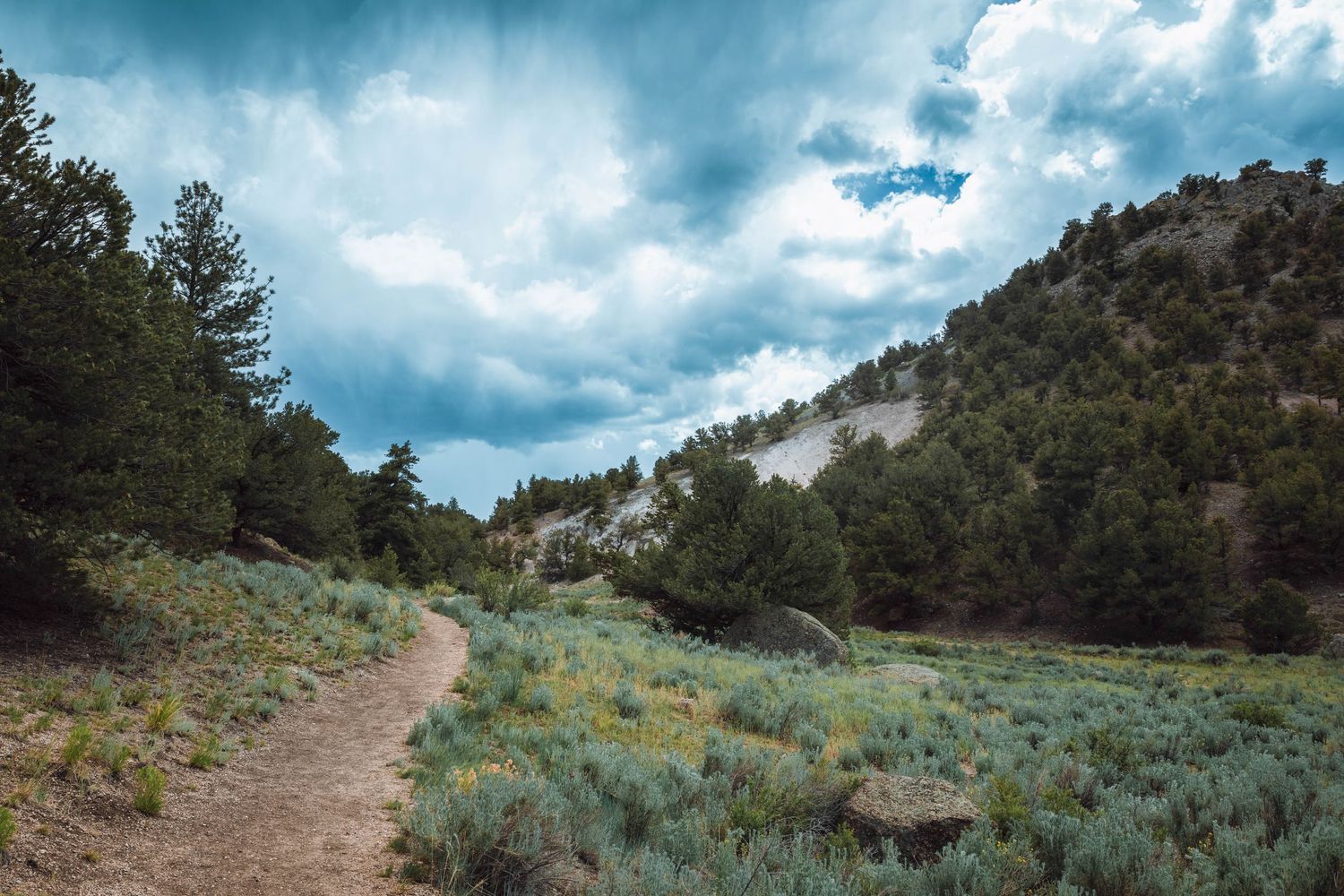
This photo was taken while I was exploring Colorado. It was not the destination that day, just something I saw between one stop and the next. A winding path, dramatic sky, mountains holding their place, clouds heavy enough to make you wonder what was coming next. It made me stop. Not because it looked easy, but because it looked honest.
That is what recovery feels like sometimes.
A path that keeps going, but not in a straight line. A sky that changes without warning. Beauty and threat in the same frame. Light breaking through, but not without clouds around it. A road that asks you to keep walking even when you cannot see very far ahead.
1 John 1:5–7 says:
“This then is the message which we have heard of him, and declare unto you, that God is light, and in him is no darkness at all.
If we say that we have fellowship with him, and walk in darkness, we lie, and do not the truth:
But if we walk in the light, as he is in the light, we have fellowship one with another…”
That is not a soft verse, but it is a loving one.
It does not let us pretend. It does not let us claim closeness with God while choosing to live in deception. It does not leave room for the kind of religious image-management that says all the right things while hiding everything that needs healing.
“If we say…”
That part matters.
Because we can say a lot.
We can say we are fine. We can say we love God. We can say we are walking in faith. We can say we are done with the thing that keeps dragging us back. We can say we have forgiven. We can say we are not bitter. We can say we are not hiding anything. We can say we are strong.
But truth is not measured by what we can say convincingly.
Truth shows up in the light.
One of the most important things I learned early in recovery was that shame is one of the most dangerous things to keep ahold of. Shame tells us to hide. Shame tells us that if people knew the truth, we would be unlovable. Shame tells us we are the only one who has ever struggled this badly. Shame tells us to keep the dark thing in the dark until it somehow magically fixes itself.
It never does.
My sponsor taught me to drag anything that looked dark into the light. Not because every thought needed to become a public announcement, and not because wisdom and privacy do not matter. But because darkness cannot survive the same way once it is exposed. A secret loses power when it is spoken to the right person. A lie starts to unravel when truth touches it. Sin festers when it stays covered, but confession opens the wound to air.
And yes, sometimes that air burns.
Proverbs 28:13 says:
“He that covereth his sins shall not prosper: but whoso confesseth and forsaketh them shall have mercy.”
That verse is blunt enough to make us uncomfortable, but there is mercy sitting right in the middle of it.
It does not say, “Whoso confesseth and forsaketh them shall be humiliated forever.”
It says mercy.
That is the part shame does not want us to believe.
Shame says exposure will destroy us. God says confession can lead to mercy. Shame says if the truth comes out, there is no coming back. God says the covered thing is what keeps us from prospering. Shame says stay hidden. God says step into the light.
There is a difference between guilt and shame. Guilt says, “This thing is wrong.” Shame says, “You are beyond help.” Guilt can lead us to repentance. Shame tries to bury us before repentance ever gets a chance to breathe.
That is why secrecy is so dangerous, especially in addiction. The lying becomes part of the addiction. The hiding becomes part of the ritual. The double life becomes exhausting, but strangely familiar. You start trying to protect the image of who you wish you were, while the real you is starving for help.
And church people are not immune to this.
Sometimes we are worse about it, because we know the language. We know how to sound okay. We know how to say “blessed” when we are bitter, “praying about it” when we are avoiding it, and “struggling a little” when the truth is that we are drowning. We know how to polish the outside of things. We know how to look righteous enough that nobody asks too many questions.
But darkness in church clothes is still darkness.
And if we keep pretending there is no darkness in us, it does not become holiness. It becomes infection.
Hidden sin does not stay small because we gave it a Christian vocabulary. It festers. It spreads. It leaks into how we treat people, how we pray, how we serve, how we judge, how we justify ourselves, and how willing we are to receive correction. The longer we protect the false image, the harder it becomes to walk honestly with God.
Jesus said in John 8:12:
“I am the light of the world: he that followeth me shall not walk in darkness, but shall have the light of life.”
Not the light of appearances.
Not the light of reputation.
Not the light of “at least I am not as bad as them.”
The light of life.
That is what Christ offers. Not just a way to look cleaner, but a way to actually live. A way out of the hidden places. A way forward that does not require us to keep lying to survive.
But following Him means we cannot keep making peace with the dark.
That is where recovery gets hard. That is where sanctification gets hard too. Because stepping into the light is not usually a one-time moment where everything suddenly feels easy. It is daily. Sometimes hourly. Sometimes minute by minute.
Recovery is not a straight road.
Faithfulness is not always a straight road either.
Some days the path feels clear and steady. Other days it feels like one wrong step could send you sliding off the side of the mountain and back into the pit. Sometimes admitting the truth feels more terrifying than the sin itself. Sometimes confession feels like falling. Sometimes saying “I messed up” feels like watching the ground disappear under you.
But falling into truth is better than standing tall in a lie.
That is something I wish more people understood. Especially people who are still trapped in active addiction, or active secrecy, or active pretending. The moment you tell the truth may feel like everything is collapsing. It may feel like shame has won. It may feel like you have ruined the image you were trying so hard to maintain.
But the image was not saving you.
Jesus does.
Ephesians 5:8 says:
“For ye were sometimes darkness, but now are ye light in the Lord: walk as children of light.”
I love that verse because it speaks to identity, not just behavior.
It does not say, “You were people who made a few dark choices.”
It says, “ye were sometimes darkness.”
That is heavy.
But then it says, “but now are ye light in the Lord.”
Not because we fixed ourselves. Not because we became impressive. Not because we finally performed righteousness well enough to earn a new name. In the Lord. That is where the change happens. That is where the identity shifts.
And then comes the instruction: walk as children of light.
Walk.
Not pose.
Not perform.
Not announce.
Walk.
Walking takes movement. It takes direction. It takes getting up again when we stumble. It takes not confusing a fall with the end of the road. A relapse, a failure, a confession, a hard day, a moment of weakness—none of those have to be the final chapter if we turn back toward the light.
That does not mean sin does not matter. It does. It means grace is stronger than the shame that tells us to stay down.
James 5:16 says:
“Confess your faults one to another, and pray one for another, that ye may be healed.”
There is healing tied to honesty.
Not careless honesty with unsafe people. Not spilling your deepest wounds in front of people who will use them as gossip or ammunition. Wisdom matters. Discernment matters. But complete isolation is not healing. Hiding everything from everyone is not healing. Pretending you are the only person in the church with something ugly to bring before God is not healing.
Confess your faults.
Pray one for another.
That is supposed to be part of Christian life. Not a place where we perform perfection for each other, but a place where truth and prayer meet, and healing has room to begin.
I think about that when I look at this photo.
The path is small compared to the mountains. The sky is heavy. The clouds are dramatic, almost overwhelming. But there is still light. There is still beauty. There is still a way through. The landscape does not become less beautiful because the clouds are there. If anything, the contrast makes the light more noticeable.
That feels true of recovery too.
The story is not beautiful because addiction was beautiful. Addiction is not beautiful. Sin is not beautiful. The lies are not beautiful. The shame is not beautiful. The wreckage is not beautiful.
But God’s mercy in the middle of it?
That is beautiful.
The courage to tell the truth after years of hiding?
Beautiful.
The humility to start over again?
Beautiful.
The person who falls and gets back up, not because they are strong enough, but because Christ is still light?
Beautiful.
The beauty does not come from the darkness.
It comes from the light that darkness could not put out.
That is why we have to stop trying to cure darkness with more darkness. We cannot shame people into freedom. We cannot lie our way into righteousness. We cannot hide sin until it becomes holiness. We cannot protect an image and call it recovery. We cannot pretend the wound is fine while it festers underneath.
Darkness cannot drive out darkness.
Only light can do that.
And Jesus is the light.
If you are in active addiction, I want you to hear this tenderly but plainly: the secret is not protecting you. It is feeding the thing that is hurting you. The lie may feel safer for a moment, but it is making the road longer and darker. You do not have to tell everyone everything, but you do need light. You need God. You need truth. You need someone safe who can pray with you and help you take the next step.
And if you are in recovery, but you stumbled, I want you to hear this too: get back up and return to the light. Do not let shame drag you into a deeper hole just because you fell. Tell the truth quickly. Reach out quickly. Pray quickly. Come back quickly. A stumble becomes far more dangerous when shame convinces you to hide it.
And if you are sitting in church every week while hiding your own darkness behind clean clothes and correct words, this is for you too.
God is not impressed by the false version of us.
He loves the real one enough to call it out of the shadows.
That is mercy, even when it hurts.
The path of recovery, repentance, and real Christian growth is winding. It has steep places. It has weather. It has moments when the clouds look too heavy and the climb feels too long. But if we keep our eyes on God and keep walking toward the light, the beauty does not cease. It may not look like the easy beauty of a cloudless day. It may be the rugged kind, the hard-earned kind, the kind you only see after telling the truth and taking another step.
But it is still beauty.
There is still a path.
There is still light.
So bring the dark thing into the open.
Name it.
Confess it to God.
Tell the truth to someone safe.
Let prayer touch it.
Let mercy meet it.
And then keep walking.
Because God is light, and in Him is no darkness at all.