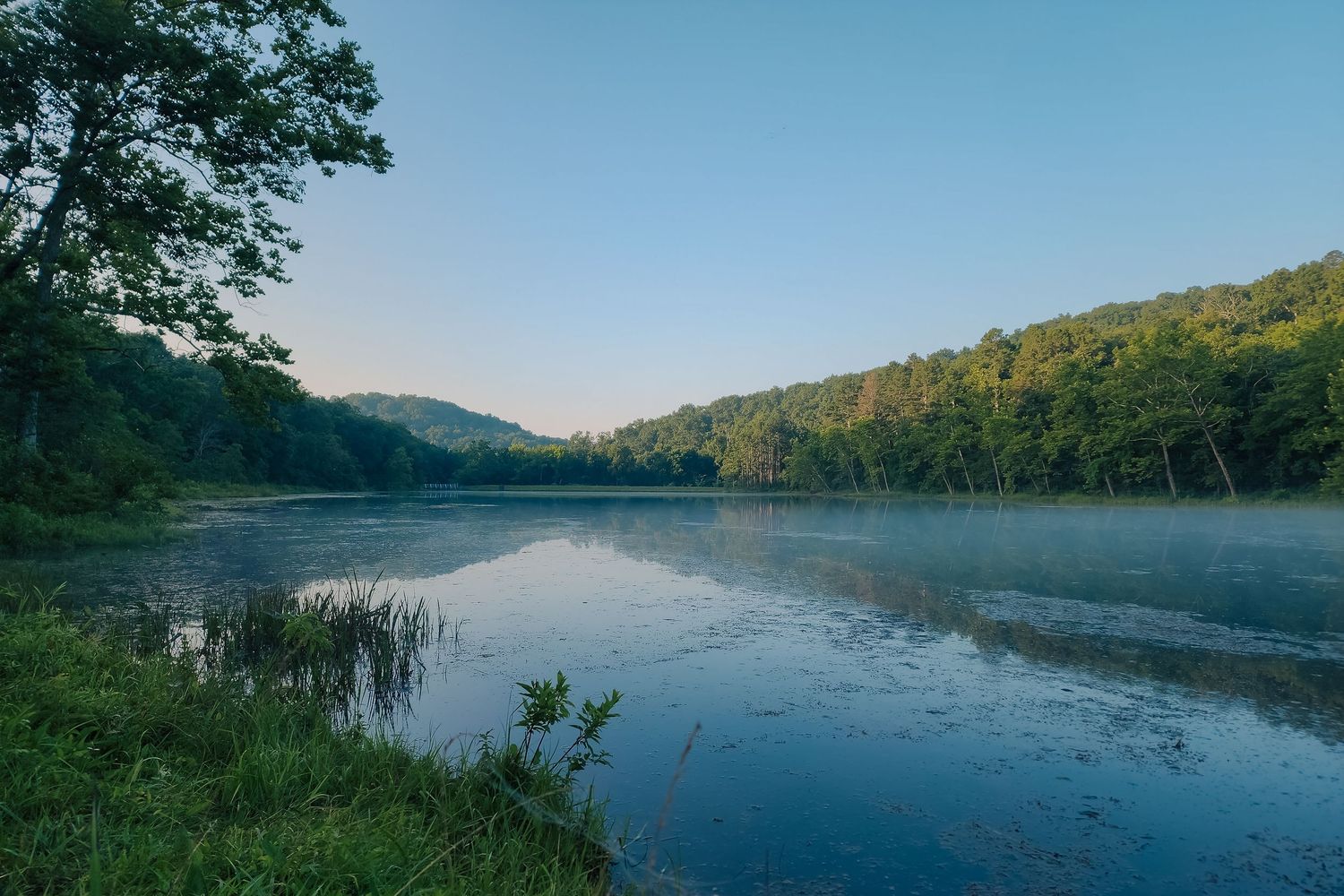
I took this photo of McCormack Lake early one summer morning, when the water was still there.
Penelope was with me, because of course she was. She has been my little road-trip shadow for years now, riding along while I wander backroads, chase old mills, pull over for wildflowers, and talk myself into turning down gravel roads that may or may not lead anywhere useful. McCormack Lake was never one of my most-visited places, but it was the kind of place worth stopping for. Quiet enough to feel tucked away. Pretty enough to make you pause. The kind of spot where my husband would eventually fish, once we moved closer and I finally brought him there.
But that morning, it was just Penelope and I.
The air was warm, but the water was holding onto the coolness of the spring. Fog lifted off the lake in soft, moving ribbons, drifting across the surface like it knew where it was going, then changing its mind. It was not just sitting there. It moved. It curled and shifted and rose in slow layers, almost like a dance. The trees held their reflection in the water. The hills sat quietly in the background. The whole scene had that early morning stillness that makes you feel like you walked in before the world was fully awake.
It was the kind of beauty you do not feel the need to explain while you are standing in it.
You just stand there and let it be what it is.
I did not know then how much I would miss it later.
I knew they were going to drain the lake. They had announced it would happen that fall, to deal with invasive grasses and moss taking over the water. So this was not one of those changes that came out of nowhere. I cannot say I was blindsided. I knew the lake was going to be lowered. I knew there was a reason for it. And sometimes knowing the reason should make things easier.
Except it does not always.
Because now, where that cool water once held the fog and reflected the trees, there is just a muddy field. And for some reason I have not been able to find, the lake still has not filled back up.
That part bothers me more than I expected.
I have tried to understand it. I have looked for answers. I have wanted a clean explanation, because clean explanations make change feel more manageable. If we can name the reason, maybe we can make peace with the loss. If we can point to the purpose, maybe we can stop feeling sad about what used to be there.
But life does not always give us that.
Sometimes the water is gone, and you know part of the story, but not all of it. Sometimes something beautiful changes, and even if there was a good reason for the beginning of that change, you still do not understand why it has not been restored. Sometimes you stand where the lake used to be and think, “I know this may have been necessary, but I still hate it.”
I think we need to be honest about that.
Change is hard.
Not just the dramatic changes. Not just the ones that split life into a before and after. Even smaller changes can ache in a strange way. A place you loved looks different. A routine disappears. A person changes. A season closes. Something that once felt steady becomes unrecognizable, and you are left trying to decide what to do with the grief of it.
That may sound silly when talking about a lake, but I do not think it is. We get attached to places. We remember who we were when we stood there. We remember the dog beside us, the morning light, the way the fog moved, the sound of water, the quiet gift of being somewhere peaceful when the world felt too loud. Places hold pieces of our lives, and when they change, it can feel like something in us gets disturbed too.
Lamentations 3:26 says:
“It is good that a man should both hope and quietly wait for the salvation of the LORD.”
That is the verse I keep coming back to with this photo.
Not because it magically fixes the sadness. It does not. Not because waiting is easy. It usually is not. And not because every earthly thing we lose comes back exactly the way we remember it.
But because there is something deeply honest about “hope and quietly wait.”
That is not loud faith. That is not polished faith. That is not the kind of faith that has a perfect answer ready before anyone asks the question. It is quieter than that. It is the kind of faith that stands beside an empty lake bed and says, “I do not understand this, and I am sad about it, but I am still going to hope.”
That kind of hope does not always feel impressive. It may not look like much from the outside. It may look like simply continuing on. It may look like driving past the muddy place where the water used to be and feeling your heart sink a little, but not letting bitterness take root. It may look like admitting that something mattered to you and that you miss it. It may look like choosing not to demand an answer from God before you decide He is still good.
Quietly waiting is not the same as not caring.
Sometimes it means caring very much, but realizing you cannot force the season to change faster than it will. You cannot make the lake fill by staring at it. You cannot make restoration happen on your preferred timeline. You cannot always dig up the reason, even if you are the kind of person who needs reasons to feel settled.
“Trust in the LORD with all thine heart; and lean not unto thine own understanding.”
Proverbs 3:5
I have always liked that verse, but I do not always like living it.
Leaning on my own understanding is exactly what I want to do when things change. I want to gather every detail, line them up, make them make sense, and decide how I feel based on whether the explanation satisfies me. I want to know why. I want to know when. I want to know what comes next. I want to know whether the thing I miss will ever look like itself again.
But trust does not always get to stand on understanding.
Sometimes trust has to stand where understanding runs out.
That does not mean we stop asking questions. I do not think God is threatened by questions. Scripture is full of people crying out, grieving, wondering, waiting, and asking how long. But there is a difference between asking God questions and making our understanding the condition of our trust.
That is the part I struggle with.
I can trust God more easily when the story is taking a shape I recognize. I can say “God has a plan” much more comfortably when I can see even a tiny piece of that plan working out. But when something just stays muddy, unresolved, and unfinished, trust feels less like a statement and more like a choice I have to keep making.
And maybe that is why this lake bothers me.
Because it feels unfinished.
I know what it looked like when it was full. I have the photo. I remember the fog moving over the water, that quiet dance on a warm summer morning. I remember Penelope being there with me, probably much more interested in smells than scenery. I remember the feeling of standing there in the cool edge of morning, before heat and noise took over the day.
Now I know what it looks like without the water.
And I do not like it.
I want to rush to the lesson and make it tidy. I want to say, “But it will all be beautiful again,” and maybe it will. I hope it will. Maybe one day the water will return, the fog will rise again, and someone else will stand there in the morning and see what I saw. I would love that.
But I also know that sometimes beauty does not come back in the form we expect.
Ecclesiastes 3:11 says:
“He hath made every thing beautiful in his time: also he hath set the world in their heart, so that no man can find out the work that God maketh from the beginning to the end.”
That verse holds both comfort and frustration.
“He hath made every thing beautiful in his time.” I love that part. I want that part. I want the reassurance that beauty is not gone just because I cannot see it right now. I want to believe there is still a time for restoration, still a time for fullness, still a time for quiet mornings and fog lifting off the water.
But then comes the other part: “so that no man can find out the work that God maketh from the beginning to the end.”
That is harder.
Because it means there are things we do not get to know all the way through. Not yet. Maybe not here. We see pieces. We see the full lake, then the muddy field. We see the morning fog, then the absence of it. We see what was, what is, and what we wish would happen, but we do not see the whole thing from beginning to end.
God does.
That does not remove the sadness, but it does give the sadness somewhere to rest.
I do not have to know the whole story to trust the One who does. I do not have to pretend I like every change. I do not have to call every loss good just because God can work through it. I do not have to look at a muddy field and fake a smile.
But I can hope.
I can quietly wait.
I can remember that change is not always an enemy, even when it feels like one. I can remember that seasons of emptiness are not always signs of abandonment. I can remember that a place can look ruined and still not be beyond repair. I can remember that God is not confused by unfinished things.
And maybe that is the bigger lesson.
So much of life is lived in unfinished places.
We wait for answers. We wait for healing. We wait for restoration. We wait for things to make sense. We wait for relationships to mend, for grief to soften, for direction to become clear, for the water to come back to places that feel dry and exposed.
Waiting does not feel holy most of the time. It feels annoying. It feels slow. It feels like nothing is happening. But Lamentations says it is good to hope and quietly wait for the salvation of the Lord.
Good does not always mean pleasant.
Good does not always mean easy.
Sometimes good means this is forming something in us we would not have chosen, but may one day be grateful for. Sometimes good means we are learning to trust without being handed every page of the story. Sometimes good means we are being taught how to grieve without becoming hard.
That last one matters to me.
I do not want change to make me bitter. I do not want the loss of beautiful things to make me stop noticing beauty altogether. I do not want disappointment to train my eyes to only look for what is missing. Because even now, even with the lake drained, that morning still happened. The fog did rise. The water did hold the reflection of the trees. Penelope and I did stand there and witness something lovely.
The fact that it changed does not erase that.
It makes me treasure it differently.
Maybe that is part of what photographs are for. Not to trap a place in the past, but to remind us that something real was there. Something worth seeing. Something worth grieving when it changes. Something worth thanking God for, even if we only got to hold it for a little while.
I think about that morning now with a little ache in me. Not a dramatic ache, just the kind that comes when you remember something simple and beautiful that is no longer there the way it was. The lake was full. The fog was dancing. The dog was with me. The world was quiet.
And I am glad I stopped.
I am glad I took the picture.
I am glad I saw it while it was there to be seen.
That may be another lesson hidden in all of this: pay attention while the water is still full.
We often assume the places we love will stay the same. We assume there will be another morning, another season, another chance to stop. We tell ourselves we will come back when we have more time, when the light is better, when life settles down.
But places change. People change. Seasons change. Sometimes faster than we expect, and sometimes even when we saw it coming, it still hurts.
So maybe the invitation is to be present while the gift is in front of us.
Not clingy. Not fearful. Not trying to freeze everything in place. Just present. Grateful. Awake enough to notice the fog moving like a dance across cool water on a summer morning.
And when change comes, because it will, maybe the invitation becomes something else.
Hope and quietly wait.
Trust without leaning so hard on your own understanding.
Believe that God makes things beautiful in His time, even when you cannot trace what He is doing from beginning to end.
I do not know why McCormack Lake has not filled back up. I do not know if it will look like this again. I hope it does. I would love to take my husband there one early morning, let him fish along the edge, and show him the fog rising off the water the way I remember it. I would love for Penelope’s old exploring spot to be beautiful in that same way again.
But I do not get to know that right now.
Right now, I have the memory. I have the photograph. I have the sadness of what changed. And I have a God who does not ask me to understand everything before I trust Him.
That is enough for today.
Maybe not enough for every question I have. Maybe not enough to make me stop missing what was there. But enough to keep my heart from turning cold. Enough to keep me watching. Enough to keep me hoping.
The lake was beautiful when it was full.
It is hard to see it empty.
But even in the empty places, God is not absent.
So I will hope.
I will quietly wait.
And I will remember the morning when the fog danced over the water.